Sam's is your source for Hatteras and Cabo Yacht parts.

Enter a part description OR part number to search the Hatteras/Cabo parts catalog:

Email Sam's or call 1-800-678-9230 to order parts.

Oil in Intercooler 12V71

It's this part from an Australian manufacturer. Very inexpensive in US$


I have purchased it only for testing the single turbo. Each of these CCvs is suitable up to 400HP, so they say. It can process 7 cubic feet per minute. A 12V71 can output 20 cubic feet per minute total at full throttle. So one for each rocker cover and a maximum capability of 14 cubic feet per minute. They should work OK for under 250hp engine output which for me is anything less than 1200rpm.

But on closer inspection of everything on our motors and having serviced everything only 8 months ago to pristine condition, we will need to bypass the oily old Walker air seps.

You can have this test CCV in a couple of weeks for US$225 and I'll include the postage. I'd be happy to obtain another for you and send that over as well.
 
Im afraid that one wouldn't work for me. My engines are 450HP Those seem to be a bit less than the Racor brand though. I am curious if replacement filters are available in the US. I didn't find a US dealer on their search page
 
We may want to re-name or create a new thread here.
 
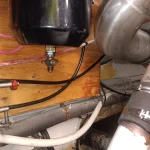
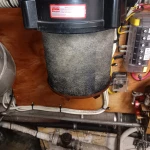
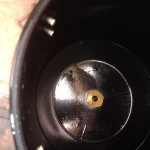
Our CCV8000 has finally a wet filter in the stb CCV assembly.
This was the engine we rebuilt near 20 years ago.
You can see in the bowl, not enough to drain out but by next oil change, a lil oil will drain out.
No oil returning to the sump. Drained by pet-cock into a jug.
Port engine still empty with a clear, 5 year old filter.

20260927_155629.webp20260927_155844.webp20260927_155850.webp
 
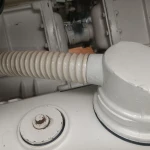
Here in the swamps, there are budget considerations. We use 1.25 & 1.5 temp rated hoses. Purchased from Hecht Rubber in Jax. They look like pool cleaning hose but are not. Over 15 years later, thousands of hours, no hose failures
Thick grey plastic Ts were used also.
Each valve cover has a vent and an old style vent from the back of the engine over a PTO outlet. All 3 outlets T'd to a single hose to the CCV.
20260927_155516.webp20260927_155527.webp20260927_155539.webp20260927_155601.webp20260927_155606.webp
 
Now filtered crank case gases back to the engine turbos;
15 years ago, I tried to use the original DDC air cans.
That lasted about a year until I came across a set of MAN filters that worked great and did aweigh with the whole DDC air cans. 10 years later those used MAN filters were getting raged.
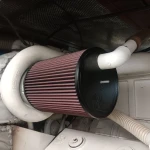
Those MAN filters are a custom size and expensive (beyond swamp budget). K&N Does make a high volume filter that will clamp rite on the 5.5" turbo inlet. We went there just a couple of years ago and all is still great.
1.5" hose to a big grey T, hose to the ends of the K&N filters.
K&N filter part number RU-3150.
My purchase direct from K&N was 20 USD cheaper than all other outlets so shop well.
20260927_155459.webp
 
This last year we have also been experimenting with advancing injector timing and making some speed/power runs in the river.
No black smoke at all proving the air filters and turbos are happy.
 
Just ordered 2 fresh filters CCV from Da Zon.
 
My goodness, Capt' Ralph. You certainly did seem to get on a roll! Thank you for sharing the photos. I never thought I too would become an expert in crankcase ventilation. Its a subject I knew little about but the past month has seen me on a vertical learning curve.

My new CCV8000 filters will be arriving with DHL next week. It was far less to purchase them in the USA and freight them over here. I have had great fun today learning about the special 1-7/8"-12 port thread. We have a fittings company here that speaks Racor language and will be able to provide 1-7/8"-12 nipples connected to a 1.25" T's and then with 1.25" hosetails. 2 sets.

What I am looking forward to most is having enginerooms and engines that by all accounts should not be covered in adirty oily film or smell.
 
This past weekend we celebrated the King's birthday here in Australia. We took the boat 20 miles north of Sydney to a harbour called Pittwater. The run north is 3.5 hours at 900 RPM and 8 knots. 32 litres or 8 US Galloins per hour.

After such a run we always run the motors up to about 1450RPM to clear them. There was always such a thick plume of blue smoke doing this, mostly from the starboard engine. It cleared after about 10 minutes (sort of). The smell of oil was thick in the air.

Remember we have just fitted the single small test CCV to the outboard side as the intercooler and turbo were oily and the basis topic of this long forum thread.

Well, this morning we ran the motors up to 1450 RPM to do the smoke test and the difference that one little CCV has made is amazing. Minimal blue smoke.

The video is taken as we head out of Pittwater with Barrenjoey Headland on the left. In the far distance directly behind the boat is The Basin. Some of you may know these landmarks.


We did the same test as we arrived in Sydney Harbour 3.5 hours later and there was very little blue smoke and very possibly from the inboard side or port engine. (I'll do an inspection of the turbo blades later in the week when the engine room has cooled down.

Our big Racor 8000 CCVs are with Fedex now.
 
Last edited:
I've never considered 1450 as "running them up". Go to 2150 for a while.
 
Just ordered 2 fresh filters CCV from Da Zon.
Update
A last minute search found a bunch of new Racor filters on e-bay. $35 each.
They were installed yesterday.
 
Very good news is that after 8 hours of running with the single test Ryco CCV on one side of the engine there is no oil ooze from the intercoolers and the turbo blades are dry. This is a huge improvement and there are no apparent turbo issues. There was no pooled oil around the turbo entrance.

Opening up the Ryco CCV, the filter media had moistened with the oil mist but there was no pooled oil in the bottom pan. I suppose at some stage the smaller filters will stop working and / or start to deposit oil in the bottom of the CCV. Doing the maths, two units would be fine for up to say 1500RPM. We only travel at 850 to 950RPM, except when clearing out the motors. Hmmmm.

+++++

The two Racor CCV8000s arrived along with all the especially ordered $$$$ stainless fittings.

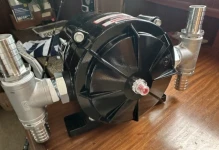
Oh my goodness, these Racor 8000 things are enormous.

I have no way of mounting them to the engine. The only place to locate each of them would be on the inside engine room wall and running very long 1-25" hoses too and from them. This is not ideal as it will be untidy with hose everywhere and I suppose the draw from the turbos would be uneven due to the differing hose lengths and their curves. A very expensive cunundrium indeed. Hmmm. Capt' Ralph seems to have them mounted at the rear of the engine room which we cannot do. Hmmm.

1792111328582.webp
Well, it certainly looks the part.

Even though the small Ryco CCV can only process half of the full output from one side of the 12V71s, it remains a simpler solution. And far better than nothing which is what I had before. Hmmmm.

1792111380254.webp
The only place to mount this Racor monster is on the inside wall. The small Ryco CCV fits neatly where the Walker vent used to be. Hmmmm.

++++

Thoughts?
 
Last edited:
I mounted mine on the side wall just above the lower access door in the hallway. OR Make a bracket from the engine or ceiling and find a place to bolt it on.

And run those Detroits up and clean them out. Our in-house mechanic that rebuilt all of our Detroits for years insisted on operators getting the RPM's up to WOT. He would get after anyone who "dogged it" and tell them to drop a gear and get your foot into it. :)
 
I can not find them but other members have installed the Racor CCVs in their ERs.
I would of hoped somebody would chime or help me find those old ER post pictures.
 
So hose length to outboard turbo should not matter?
 
Someone on here was selling paired smaller units for ease of mounting. I misread their post and thought it was both of them for the price and accidentally ordered one and thought I was getting two. Anyway I am saying that to say you can put one of each of the smaller ones to a turbo if that helps with you engine room. I need one 600 per engine and plan to install this winter
 
A quick update...

I have mounted the CCVs to the walls and worked out my final fittings purchases and hose runs. Gonna buy a couple of valves. Should all work.

Limited over here in Oz for hose types. Pity we dont have Hecht Rubber here.

I'd like to use some high quality black spiral bilge hose but probably not suited to engine heat or petrochemicals. Bendy rubber type fuel hose seems excessive and bulky.
 

Forum statistics

Threads
39,314
Messages
466,015
Members
12,967
Latest member
MikeV

Latest Posts

Trending content

Back
Top Bottom