Sam's is your source for Hatteras and Cabo Yacht parts.

Enter a part description OR part number to search the Hatteras/Cabo parts catalog:

Email Sam's or call 1-800-678-9230 to order parts.

Isolator

  • Thread starter Thread starter Teddyjensen
  • Start date Start date
  • Replies Replies 20
  • Views Views 1,278

Teddyjensen

Member
Joined
Jul 7, 2021
Messages
42
Status
  1. OWNER - I own a Hatteras Yacht
Hatteras Model
42' CONVERTIBLE (1971 - 1978)
What size of an isolation transformer are some of you using for a boat in the 60 ft range, im thinking 3600v would that be big enough ? Thoughts ? Tackling the dreaded breaker issues for the new box breaker issues for the ground fault
 
Size it for amp draw. A 50a service needs a 50a transformer.
 
50 amps is 12,500 watts. Dont buy too small of a unit or it won't work.

I sell many 50 amp a larger units.
 
Not exactly sure what you're attempting to do, but know that an isolation transformer will not cure electrical leakage on the boat side. sounds like you're tripping the dock ground fault protection. Only residual current devices will shut off power due to a fault. The isolation transformer primary side will have equal current but the secondary side may not due to boat issues. You should find the source of leakage. The secondary side circuits can have leakage and no one knows it until that person makes the bridge back to the return side, then they are shocked. Its like just leaving a hot wire laying around waiting for someone to touch it. The transformer doesn't know how much current should be returning so it only supplies whats being asked for, until the potential electrical leakage is returned to the transformer by a person. May end up being less expensive to correct the issue than install a transformer. A surface mount ELCI is a lot less expensive than a transformer if you need to meet survey recommendations. if you have neither a transformer or an elci presently, the elci will provide far greater safety overall..
 
Last edited:
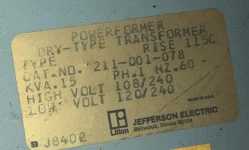
Just acquired the boat, as you can imagine not much documentation on it, right now there are two of these on board tied to separate breakers at the main panels pretty sure they are original and not sure if they even work, haven’t dug into them, hard to find to much info on them but i have just begun looking, any way to explain how to test that a non electrician can understand, thanks for the input so far
IMG_7004.webp
 
If you are tripping the dock EFCI check you washer dryer. I did not know I had a problem until I tried to use my WD when I got the boat home. In Texas the WD worked fine. In Pensacola the dock has a EFCI and the WD would trip the breaker. Got a Marine elcetrician to check it. We had to slide out the WD and he changed the neutral ground hook up. It solved the problem. Also the Aft Deck AC would trip thr dock breaker. Gound out it had a loose neutral. Sparky repaired it and my dock triping is solved.

Not sure if this is a problem, but thought I would share.
It all helps, just have to do one system at a time, I’ll eventually find the bugger
 
OP, you mention that you have 2 transformers. Does your boat have both a 50A and a 30A shore power connection? If so that is a great feature. You can plug into 1 30A pedestal and it will make 120/240 on the boat. Just limit what you use. Also ( I bet you already searched entire boat but worth mentioning) look for a gray plasic box onboard. Hatteras supplied drawings and other manuals in these gray boxes. Not sure when that started.
 
Many older full size appliances used to bond N and G which will trip dockside GFCIs. Washer dryers, stove / range, oven, etc. Disconnect them and see if that solves the tripping. You need to disconnect them, turning off the breaker will not disconnect the N.
 
Oddly, mine only tripped the dock when I tried to use the WD or turn on the Aft deck AC.
 
Your transformers are working if still wired as original. If they were not, you'd have no power at all. You have two of them because one is for your source 1 inlets and one is for source 2
 
The dock likely has a ground fault interrupt of 100 milliamps. A boat side ELCI is 30 milliamp. the head/galley/wet area gfci is 5 milliamp. If you can find a ground fault interupter under 100 milliamp to place between your boat and the shore power pedestal you can test all day long without tripping the dock interrupter and pissing off the dock master. The reason for the increasing milliamp the further upstream the system goes is to reduce nuisance trips. Shut off all your load circuits and turn each on independently with loads turned on to see which circuit the fault is on.
 
If you are tripping the dock EFCI check you washer dryer. I did not know I had a problem until I tried to use my WD when I got the boat home. In Texas the WD worked fine. In Pensacola the dock has a EFCI and the WD would trip the breaker. Got a Marine elcetrician to check it. We had to slide out the WD and he changed the neutral ground hook up. It solved the problem. Also the Aft Deck AC would trip thr dock breaker. Gound out it had a loose neutral. Sparky repaired it and my dock triping is solved.

Not sure if this is a problem, but thought I would share.
New washer/dryer i didn’t install so thats a good point as well as the ac
 
Your transformers are working if still wired as original. If they were not, you'd have no power at all. You have two of them because one is for your source 1 inlets and one is for source 2
Great point
 
Many older full size appliances used to bond N and G which will trip dockside GFCIs. Washer dryers, stove / range, oven, etc. Disconnect them and see if that solves the tripping. You need to disconnect them, turning off the breaker will not disconnect the N.
Definitely looking ar the appliances
 
OP, you mention that you have 2 transformers. Does your boat have both a 50A and a 30A shore power connection? If so that is a great feature. You can plug into 1 30A pedestal and it will make 120/240 on the boat. Just limit what you use. Also ( I bet you already searched entire boat but worth mentioning) look for a gray plasic box onboard. Hatteras supplied drawings and other manuals in these gray boxes. Not sure when that started.
I have port and stb plug ins, so two 50 amp transformers
 
New washer/dryer i didn’t install so thats a good point as well as the ac
On boats the grounded (neutral) and grounding (green) are never brought together except at the source of power. The source of power is a few things. When tied to the dock the source of power is the dock pedestal or the secondary side of the isolation transformer, if equipped. When on generator the source of power is the gen set. When on inverter the source of power is the inverter. Only one of these points at any one time has the grounded and grounding wires brought together. So the other posters are entirely correct on the appliances but if a residential electrician was monkeying around on board, he likely didn't know this and would tie the grounded and grounding together at the panel board. A major difference between terrestrial and marine electrical is exactly this. use an ohm meter to check continuity between grounded and grounding with the system powered down and you'll know if you have this problem.
 
Another check, if you have an amp clamp that registers milliamps, is to check the current on each conductor off the transformers separately but with a little load like a light bulb. If not the same reading, within around .3 milliamp, between ungrounded (hot) and grounded then there is leakage. Check the grounding conductor with the amp clamp to see if that is where the missing current is. do this with all circuits off and then with turning on individual circuits with all the loads on that circuit on to see what individual circuits have for leakage. There is always some difference due to inefficiencies of the transformer and insulation degradation etc but approx .5 milliamp difference or less is what you want to see for individual circuits and around 1to 1.5 milliamp for the entire system in operation. This little exercise of checking the current on each conductor and comparing them to each other is exactly what the dock ground fault device is doing, except its doing its job at around the speed of light .
 
Last edited:
By reducing the loads over the last several days i have isolated the issue to the sentry 32v battery charger, now to trace the wiring
 
By reducing the loads over the last several days i have isolated the issue to the sentry 32v battery charger, now to trace the wiring
Is it too much load or a bad charger. Is it 120 or 240?

New chargers are in stock if you want to upgrade to an analytic.
 

Forum statistics

Threads
39,256
Messages
465,368
Members
12,940
Latest member
jpaul200

Latest Posts

Trending content

Back
Top Bottom